The recent celebration of the 65th Independence Day of Cyprus was far more than a ceremonial event. It served as a meaningful opportunity to highlight the history and resilience of the Cypriot people, while also showcasing the continuous strengthening of ties between Cyprus and Israel.
In this context, the Embassy of Cyprus and the Commercial Trade Center (CTC) of the Embassy in Tel Aviv, in collaboration with leading Israeli business organizations—such as the Federation of Chambers of Commerce, the Export Institute, the Manufacturers Association, and the Israel-Cyprus Chamber of Commerce—hosted an exclusive Business Leaders Forum.
The event brought together influential Israeli business leaders and investors for a direct exchange with the Minister of Energy, Commerce and Industry of the Republic of Cyprus, Mr. Giorgos Papanastasiou. Discussions focused on identifying new opportunities to strengthen bilateral economic relations, particularly in strategic sectors such as energy, logistics, and technology.
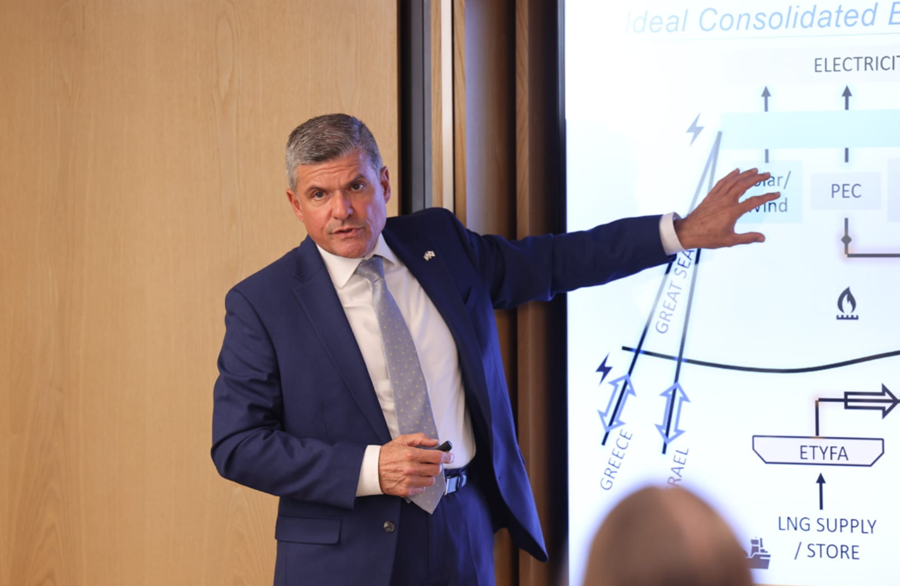
Minister of Energy, Trade and Industry of the Republic of Cyprus Mr. Giorgos Papanastasiou during his presentation.
Moderated by CTC Director Sofronis Papageorgiou, the forum emphasized the depth and scope of the commercial relationship between the two countries, spanning goods trade, innovation, tourism, healthcare, and multi-sector investment.
The numbers speak for themselves
In 2024, bilateral goods trade exceeded $1.1 billion, while Israeli exports of business services to Cyprus reached nearly $2 billion, making Cyprus the fourth most important destination for these services. Likewise, Israeli foreign direct investment in Cyprus continues on a strong upward trend.
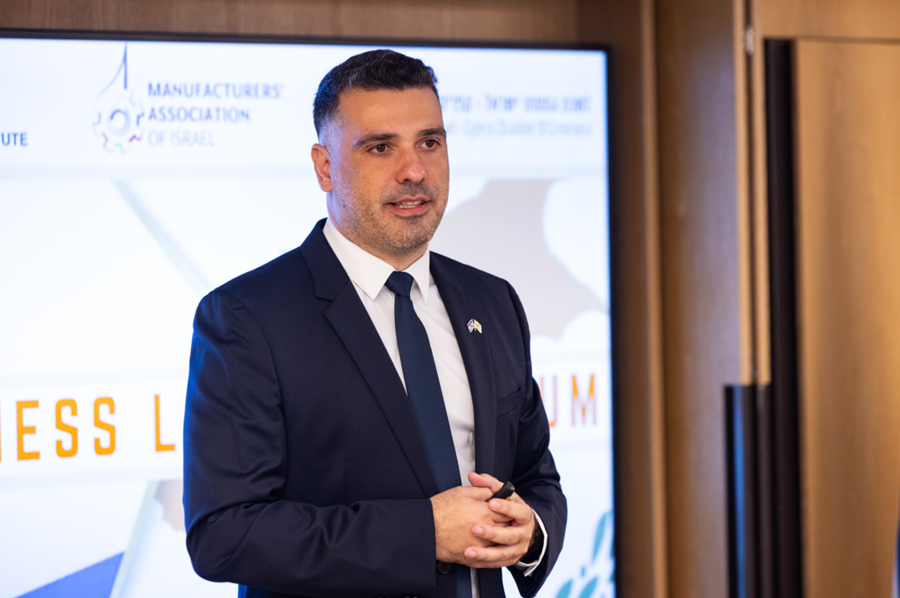
Director of the CTC, Sofronis Papageorgiou
Minister Papanastasiou also presented Cyprus’s national energy strategy, highlighting key priority areas and investment opportunities. He was accompanied by senior representatives from Invest Cyprus and the Cyprus Chamber of Commerce and Industry, who provided an overview of the country’s economic outlook and practical guidance for interested companies.
Members of the Cyprus-Israel Chamber of Commerce in dialogue with the Minister of Energy, Trade and Industry of the Republic of Cyprus, Mr. Giorgos Papanastasiou
This event, held in the context of Cyprus’s independence celebration, not only reflected the shared commitment to dialogue, innovation, and joint development, but also reaffirmed both countries’ desire to build a strategic, robust, and long-term partnership.
From left to right, the President of the Israel-Cyprus Chamber of Commerce León Amiras and the Ambassador of Cyprus, Mr. Korneliou S. Kornelious
To close the event, León Amiras, President of the Israel-Cyprus Chamber of Commerce, emphasized the international relevance of the forum and the shared vision for the region’s energy future:
“This was a high-level international event, with the Cypriot Minister of Energy delivering a fascinating presentation on the economic potential between Cyprus and Israel—especially in the gas sector. According to the announcement, from 2027 Cyprus will begin supplying energy to Israel and other countries in the region. The Minister, an expert in the field, impressed us with top-tier technical solutions,” Amiras stated.
He also highlighted the strategic importance of the partnership:
“Once again, we have shown the strong brotherhood between Cyprus and Israel in all matters related to energy, innovation, and technology, setting aside extremist ideas of war.”
In a constantly shifting Middle East, energy and diplomatic interests are once again intertwining. The signing of the Abraham Accords in 2020 marked a turning point in the relations between Israel and several Arab countries, opening new possibilities for economic cooperation in key sectors like energy.
However, the Hamas offensive of October 7, 2023 reignited tensions in the region, generating uncertainty among investors and regional partners. Nevertheless, the accords remain in force, and economic ties continue to strengthen, as demonstrated by the recent gas export agreement between Israel and Egypt.
Cyprus: A New Player in the Energy Game
In this context, Cyprus is emerging as a key player. Although not a signatory to the Abraham Accords, its control over vast Exclusive Economic Zones (EEZ) in the Eastern Mediterranean gives it a strategic role in the exploitation and distribution of energy resources. Its geographical location and political stability position the island as a vital link in the region’s new energy landscape.
Key Details of the Israel–Egypt Gas Deal
Signed in August 2025, the agreement between Israel and Egypt is the largest in Israel’s energy history, with an estimated value of $35 billion. The contract states that Egypt will purchase 130 billion cubic meters (bcm) of natural gas until 2040, in two phases:
Phase 1 (2026): Supply of 20 bcm to Egypt, following the completion of the third pipeline on the Ashkelon–Ashdod route.
Phase 2: Expansion via a new pipeline from Nitzana, enabling the addition of 110 bcm and raising the annual supply to 12–13 bcm.
This agreement not only strengthens the Israel–Egypt energy alliance, but also consolidates Egypt’s role as a regional energy hub. At the same time, it creates new opportunities for Cyprus, which—though not directly involved—benefits indirectly from its strategic infrastructure and location.
Cyprus: The Future Energy Hub
Cyprus’ position in the Eastern Mediterranean, along with its control of maritime zones with high energy potential, makes it a key piece of the regional energy ecosystem.
One of the main advantages for Nicosia is the possibility of becoming a logistics and transit hub for Israeli gas, especially if projects such as liquefaction terminals on the Cypriot coast or submarine connections to Europe are activated.
Additionally, Cypriot and international companies operating on the island could participate in infrastructure, storage, transport, and technical services, generating skilled employment and foreign investment.
In the medium term, Cyprus’ role as a connection point between producers (Israel, Egypt) and consumers (EU) could accelerate long-discussed projects like the EastMed pipeline, now revitalized by Europe’s need to diversify energy sources following the war in Ukraine.
From left to right: Gaston Saidman, Commercial Attaché of the Embassy of Cyprus in Israel Sofronis Papageorgiou and CEO of the Israel-Cyprus Chamber of Commerce Eran Cohen
Interview with Eran Cohen, CEO of the Israel–Cyprus Chamber of Commerce
To learn more about the opportunities emerging for Cyprus in this new energy scenario, we spoke with Mr. Eran Cohen, CEO of the Israel–Cyprus Chamber of Commerce, who shared his insights on Cyprus’ growing role as a regional energy actor.
From left to right Gaston Saidman, Commercial Attaché of the Embassy of Cyprus in Israel Sofronis Papageorgiou and CEO of the Israel-Cyprus Chamber of Commerce Eran Cohen
G.S – How do you assess Cyprus’ current role in the new Eastern Mediterranean energy landscape following the Israel–Egypt deal? E.C – Cyprus is not directly affected at this time by the gas deal between Israel and Egypt, but it will have an impact in the coming years when Cyprus starts exporting gas from its maritime territory.
G.S – Do you see specific opportunities for Cyprus to become a logistics or tech hub within the gas supply chain? E.C – As is well known, Cyprus has discovered large gas reserves in its maritime territory, similar to those found in Israel’s maritime zone. The potential of these reserves is estimated in the tens of billions of euros. Cyprus is expected to begin gas exports in about six years, since the country itself consumes little gas, meaning most of it will be exported. Infrastructure already exists via Israel to reach Jordan and Egypt. Depending on political developments in the Middle East, Lebanon and Syria may also benefit from Israeli and Cypriot gas in the coming years. This potential could bring billions in royalties and tax revenue to Cyprus.
G.S – Which sectors of the Cypriot economy could directly benefit from this energy expansion? E.C – Currently, several companies in Cyprus hold licenses to produce gas, including Delek (Israel) and U.S. firms Exxon and Chevron. The sooner Cyprus can export gas, the greater the potential growth of its economy.
With Attorney León Amiras, President of the Israel-Cyprus Chamber of Commerce
León Amiras, President of the Israel–Cyprus Chamber of Commerce, added:
“At a time when the State of Israel faces not only military challenges but also a diplomatic battle for international recognition of its fight against Islamic terrorism, economic agreements such as this gas deal represent a strategic boost. These kinds of initiatives not only strengthen Israel’s economy but also consolidate its ties with regional allies like Cyprus and project stability to the international community. In that sense, this is a historic agreement.”
Conclusion
The new energy agreement between Israel and Egypt not only redefines alliances in the Eastern Mediterranean but also opens a window of opportunity for players like Cyprus. While its role is still emerging, all signs suggest that its projection as an energy, logistics, and geopolitical hub will become increasingly relevant in the coming years. In a global context where energy security is a top priority, the small Mediterranean island faces a historic opportunity.
The recent agreement (10.2025) between Israel and Hamas brings hope, although there remains a degree of uncertainty regarding Israel’s underlying motivations and concerns. However, the Israeli mindset always inclined toward life leads many to experience this moment almost like a festive ceremony: for one day, they choose to forget what has happened and force themselves to awaken from the nightmare that has shaken the Middle East over the past two years.
The ceasefire and the return of hostages to their homes mark the beginning of a new phase. Will it be challenging? Yes. But this context invites us to reflect on how an open Middle East, increasingly connected to global markets, could transform the region’s economic and geopolitical landscape. This could activate an unprecedented dynamic of cooperation and competition especially among those aligned with the Abraham Accords.
The Abraham Accords and a Redefined Region
The Abraham Accords represent a significant shift in the regional order. They have not only opened access to new markets—particularly in sectors like security and technology—but also unlocked economic opportunities in investment, tourism, and trade. Politically, the formal establishment of relations between Israel and countries like the United Arab Emirates, Bahrain, Sudan, and Morocco signals the beginning of a new era.
Positive changes are on the horizon, and they will follow their own course. What matters is being present—before, during, and alongside those who will shape the key elements of tomorrow’s global economic landscape.
The Israel-Hamas Agreement: A Pause for Economic Realignment?
We find ourselves at a crossroads: markets are relatively calm, offering a critical moment to plan our next steps—not only as investors and entrepreneurs but, above all, as innovators seeking to play an active role in the region and compete at the highest level.
This does not imply we can afford to be complacent. On the contrary, it’s a call to carefully evaluate emerging opportunities and engage in the process. When regional market success begins to consolidate and become visible, we must already be positioned—not starting from scratch.
Ceasefires in this region often spark a sense of opportunity. Israel, in particular, is seen as a country with a strong economy based on its greatest asset: human capital. Its deeply innovative society has led to transformative developments. A prime example is its pioneering work in desert irrigation technology—solutions that now benefit the world. This is the mindset: to see opportunity where others see obstacles. With this vision, the sky is not the limit—it’s only the beginning.
This agreement could facilitate border stabilization and improve the flow of goods. That would not only strengthen economic cooperation but also enhance humanitarian aid. All of this is possible within a more stable environment—one that fosters investor confidence and operational security.
As previously mentioned, Israel has long been a hub of innovation and startups. In this context, the Palestinian territories could represent a new frontier of opportunity—where entrepreneurs and businesses might contribute to infrastructure development, service delivery, and job creation.
Future regional entrepreneurs will have the chance to collaborate and benefit from projects aimed at preventing social deterioration—especially in Gaza—sharing both the challenges and the economic gains among all stakeholders.
Direct and Indirect Economic Implications
Expanded Regional Cooperation
Within the framework of the Abraham Accords, this new agreement could act as a catalyst for deeper economic and strategic integration with Gulf nations such as the UAE, Bahrain, and Saudi Arabia. While the latter has yet to normalize relations with Israel, it has signaled interest in a more stable and cooperative regional future.
Gulf nations, with their significant financial and strategic capacities, have shown growing interest in fostering regional stability as a prerequisite for sustainable economic development. This is already reflected in joint investment projects in technology, renewable energy, infrastructure, and tourism—many involving cooperation between Israeli and Emirati companies.
A broader cooperative agenda could also include regional logistics corridors, energy integration initiatives (such as cross-border electricity grids or green hydrogen ventures), and shared platforms for technological innovation.
The Strategic Role of Cyprus
In this emerging landscape, Cyprus plays an increasingly important role as a bridge between the Middle East and Europe. Its geographic proximity and strong ties with both Israel and Arab nations make it a natural hub for regional logistics, diplomacy, and energy infrastructure.
Members and directors of the Israel-Cyprus Chamber of Commerce at an investment event
Ongoing trilateral cooperation among Israel, Cyprus, and Greece—particularly in the energy sector—has already laid the groundwork for long-term strategic alignment. Projects such as subsea interconnectors and potential gas pipelines linking the Eastern Mediterranean to Europe illustrate how Cyprus can contribute to diversifying export routes, enhancing energy security, and promoting regional interdependence.
Moreover, as a member of the European Union, Cyprus can serve as a conduit for EU-backed development initiatives in Gaza and the West Bank. These could include investment in reconstruction, education, and employment—aligned with European frameworks for peace-building and regional inclusion.
Finally, Cyprus’s neutral diplomatic stance and historical commitment to regional dialogue offer the potential for it to act as a platform for conflict resolution and economic diplomacy—key elements in shaping a stable, prosperous Eastern Mediterranean.
Risks and Challenges
Of course, the path forward is not without challenges. The armistice itself does not eliminate the deeper structural issues: internal political fragility, mutual distrust, and external pressures that could obstruct effective implementation.
In the Middle East, a single misstep can trigger a domino effect—undermining trust and projecting risk to international investors. Yet, history shows that breakthroughs often emerge in precisely such complex contexts—when political will, strategic vision, and committed actors align toward long-term development.
With sufficient effort and perspective, this moment may represent a rare opportunity to build a strong foundation for regional cooperation—one that delivers shared value. The obstacles are real, but so is the potential for transformative progress.
Conclusion
From an economic standpoint, the Israel-Hamas agreement should be seen as a pragmatic opportunity to stabilize a key region—aligned with the broader vision behind the Abraham Accords. The economy can serve as a bridge to peace, provided that all stakeholders maintain a sustained commitment to cooperation, innovation, and effective risk management.
In this evolving equation, Cyprus emerges as a strategic partner—linking the Middle East with Europe and enhancing the region’s ability to pursue lasting peace through connectivity, investment, and shared prosperity.